

By Damon K. Jones | Publisher, Black Westchester Magazine
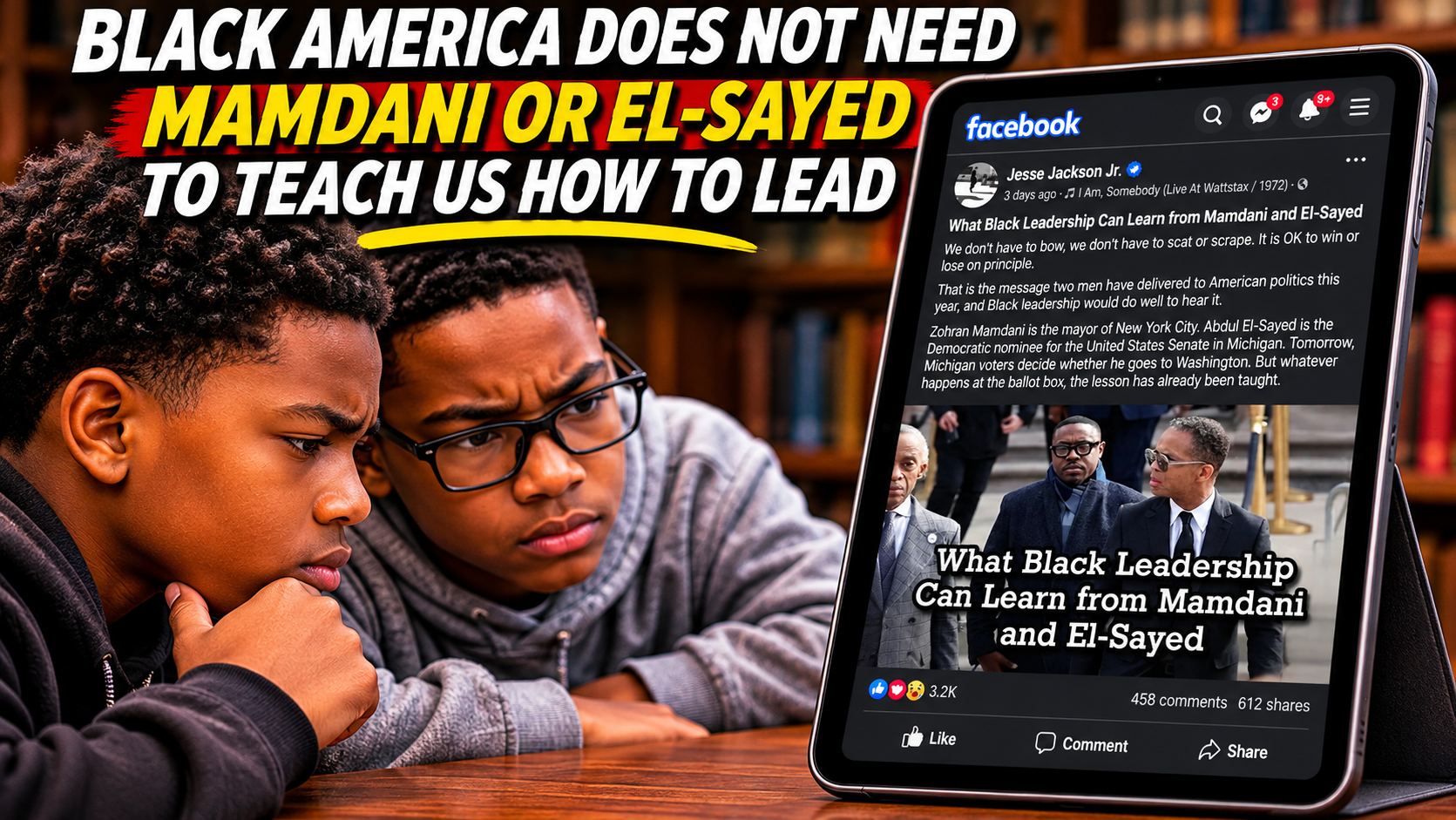
I read Jesse Jackson Jr.’s Facebook article, “What Black Leadership Can Learn from Mamdani and El-Sayed,” and had to ask myself a serious question. Have we, as Black Americans, become so disconnected from our history, so politically dependent, and so desperate for someone else to lead us that we now need two men who have never lived the Black American experience to teach us how to stand on principle? Are we really at that point as a people?
We are descendants of men and women who survived slavery, Jim Crow, lynching, segregation, economic exclusion, and generations of government-sanctioned discrimination. Our ancestors built churches, schools, businesses, newspapers, and entire communities even as this country refused to recognize their humanity. They organized politically even when speaking out could cost them their jobs, their homes, and even their lives. Yet somehow, we are now being told to look to Zohran Mamdani and Abdul El-Sayed for lessons in political courage.
Let me be perfectly clear. I believe Black America must lead Black America. I am not interested in outsourcing our leadership, political agenda, or definition of courage to people who have never experienced our specific historical struggle. We can build coalitions and work with other communities, but those relationships should never require us to surrender our identity, priorities, or responsibility to lead ourselves.
Have We Forgotten Who We Are?
What troubles me most about Jesse Jackson Jr.’s argument is that he knows our history. He was born into a family that helped shape modern Black political organizing, yet his article holds up two politicians outside our historical experience as models for what Black leadership should become.
Frederick Douglass challenged slavery without asking permission. Harriet Tubman risked her life to free enslaved people. Ida B. Wells confronted lynching, knowing that telling the truth could get her killed. Marcus Garvey preached Black economic independence and the building of institutions. Booker T. Washington built Tuskegee around education, skilled trades, and economic development.
Elijah Muhammad taught the importance of doing for self and building Black economic institutions. Malcolm X challenged our political dependency, while Martin Luther King Jr. confronted the political establishment over civil rights, poverty, and economic justice. Shirley Chisholm and Dr. Lenora Fulani challenged the political system and ran for president long before Barack Obama entered the White House.
And what about Jesse Jackson Sr.? His presidential campaigns in 1984 and 1988 challenged the Democratic establishment and demonstrated that Black Americans could organize nationally around a political vision. Jesse Jackson Jr. was not simply reading about that history in a textbook. He grew up inside it. He witnessed a blueprint for independent Black political leadership firsthand.
So why are we looking to Mamdani and El-Sayed to teach us something our own ancestors and leaders demonstrated generations ago? Our problem is not a lack of historical examples. Our problem is that we have forgotten what those examples were supposed to teach us.
We Have Traded Independence for Grants, Money, Fame, and Favor
Here is the conversation too many Black political leaders do not want to have. Somewhere along the way, we allowed political access to replace political independence. Too many people who claim to represent Black America have become more concerned with maintaining relationships with party officials than with producing measurable improvements in the communities they supposedly serve.
Government grants, political appointments, consulting contracts, campaign contributions, and access to powerful people have become the currency of political loyalty. Organizations that should be holding elected officials accountable sometimes become dependent on those officials for their survival. When the money starts flowing, criticism often stops, and suddenly everybody is talking about relationships instead of results.
I served as a Democratic district leader, so I am not speaking from the outside. I have been inside the political machinery. I understand how endorsements are negotiated, how political favors are exchanged, and how loyalty is rewarded. I also know what happens when you refuse to go along just to get along.
Too many of our so-called leaders have become gatekeepers for political establishments rather than advocates for Black people. They can tell you who controls the party committee, who is getting an appointment, and who is next in line for an endorsement. But ask them for a serious plan to build Black wealth, expand homeownership, develop Black businesses, or create economic independence, and the conversation becomes uncomfortable.
Our ancestors fought to escape slavery, yet too many of us have voluntarily surrendered our political independence to parties through dependency, fear, and the pursuit of personal advancement. We have become so comfortable receiving political favors that we have forgotten the difference between individual rewards and collective advancement.
We Have Forgotten Our Spiritual Foundation
Jesse Jackson Jr. overlooks another part of this conversation. Neither Mamdani nor El-Sayed comes from the spiritual and historical experience that sustained generations of Black Americans through slavery, segregation, and the civil rights movement. Our ancestors did not simply organize politically. They organized spiritually, and their faith helped them endure conditions that many of us today cannot begin to imagine.
The Black church was more than a place to worship on Sunday. It was a foundation for education, economic cooperation, political organizing, and community development. Faith in God helped sustain our people when the government refused to protect them.
Proverbs 29:25 (KJV) tells us, “The fear of man bringeth a snare: but whoso putteth his trust in the LORD shall be safe.”
That scripture speaks directly to what I see happening in Black politics today. Too many leaders fear losing political relationships, government funding, appointments, and access more than they fear abandoning their own people’s interests. Our ancestors understood that standing on principle sometimes meant standing alone. Today, too many politicians are waiting for permission from party leadership before they open their mouths.
What Exactly Is Black America’s Political Agenda?
Jesse Jackson Jr. praises Mamdani and El-Sayed for standing firmly behind their political agendas. That is fine, but I have a more important question. What exactly is Black America’s political agenda, and who is standing firmly behind it?
Where is our national strategy for Black homeownership, Black-owned businesses, financial institutions, skilled trades, entrepreneurship, technology, and economic development? Where is the serious commitment to improving Black education, strengthening Black families, addressing health disparities, and creating generational wealth? Where is the accountability for politicians who have spent decades collecting Black votes while our communities continue struggling?
We have Black elected officials at virtually every level of government. We have political organizations, consultants, advocacy groups, and political action committees. Yet we continue debating whether Black Americans should demand a specific agenda from politicians seeking our support.
Mamdani has his agenda, and El-Sayed has his agenda. Their supporters understand what they are organizing around. Meanwhile, too many Black political conversations begin and end with which Democrat we need to elect next, as though electing another politician automatically improves the lives of Black families.
That is not a political strategy. That is a political habit, and it is a habit we desperately need to examine.
Stop Confusing Representation With Power
One of the greatest mistakes we have made is believing that having Black faces in powerful positions automatically means Black America has gained power. Representation is important, but representation without measurable results is nothing more than political symbolism.
A Black mayor does not automatically create Black wealth. A Black member of Congress does not automatically improve Black schools. A Black political appointee does not automatically create opportunities for Black-owned businesses. If our communities remain economically dependent, our children continue struggling academically, and homeownership remains out of reach, then we have every right to ask what those political victories have produced.
We have become experts at celebrating elections without demanding a return on our political investment. When someone challenges that arrangement, they are accused of dividing the community, helping Republicans, or betraying Black voters. Yet when Mamdani or El-Sayed challenges the establishment, we are told to admire their independence and courage.
Why is political independence celebrated when other communities exercise it but treated as disloyalty when Black Americans demand it? That is the contradiction Jesse Jackson Jr. should be addressing, especially considering the political history of his own father.
Black America Must Lead Black America
I am tired of hearing that Black Americans need to learn how to organize, negotiate, and stand on principle from politicians who have never lived our historical experience. Our ancestors already gave us that knowledge. What we have lost is the determination to exercise it.
We have allowed political parties to define our priorities, outside organizations to shape our conversations, and political funding to influence which Black voices are heard. Too often, wealthy political interests determine who receives support, who gets access, and who is considered a legitimate Black leader.
That is not liberation. That is dependency dressed up as political participation, and it has become so normalized that some people cannot imagine Black America functioning politically without permission from the Democratic Party.
Black America must develop its own leadership, establish its own agenda, strengthen its own institutions, and hold its representatives accountable. Coalitions are not the problem. Surrendering our interests inside those coalitions is the problem, and we must stop confusing cooperation with submission.
Only Black America Can Save Black America
Jesse Jackson Jr., your father helped demonstrate that Black Americans could challenge the political establishment and organize around a national vision. That history should remind us of our capacity for leadership, not prompt us to search for political role models outside our community.
Our ancestors survived slavery without surrendering their humanity. They built institutions under Jim Crow, organized movements without political protection, and understood that freedom required more than access to someone else’s political organization. They valued ownership, education, faith, discipline, family, and economic independence.
We have forgotten too much of that history. We have traded independence for political comfort, collective advancement for individual opportunity, and community accountability for party loyalty. Now we are being told that two politicians who have never lived through our history are supposed to remind us how to stand up straight.
As Black men, descendants of American slavery, we do not need anyone else telling us how to stand, lead, fight, or what we should do for our own people. Our ancestors have already shown us through their sacrifices, taught us through their struggles, and left us a blueprint written in blood, faith, courage, and determination. The Scriptures have already commanded us to be men of faith, wisdom, strength, discipline, and responsibility. We have no excuse for abandoning what was handed down to us.
The problem is not a lack of leadership examples. The problem is that too many of us have grown comfortable following everyone else’s agenda while neglecting our own. We have allowed political parties, wealthy donors, and people outside our historical experience to dictate what leadership should look like for Black America.
As Black men, descendants of American slavery, we do not need another community to tell us who we are or what our responsibilities are. Our ancestors showed us. Our elders told us. And the Scriptures have demanded it of us.
Black America must lead itself, because only Black America can save Black America.
