

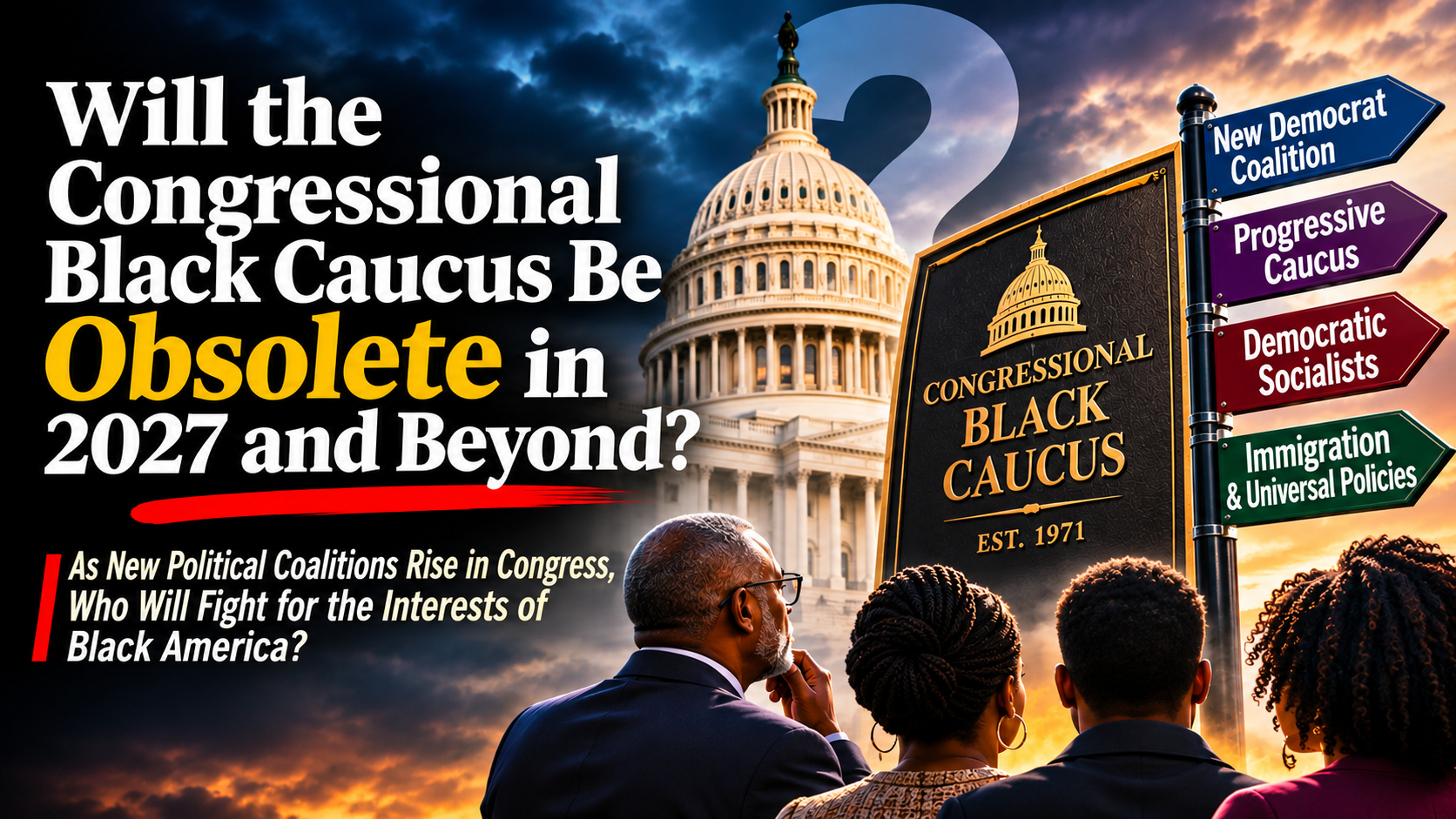
As New Political Coalitions Rise in Congress, Who Will Fight for the Interests of Black America?
For decades, Black Americans have been told that the Democratic Party is our political home. Black elected officials, civil rights organizations, church leaders, and political activists have sold us the idea that electing Democrats automatically means protecting the interests of Black America. We have been conditioned to believe that when Democrats win, Black America wins. But as we prepare to enter 2027, I have a serious question that Black America needs to start asking. Will the Congressional Black Caucus become politically obsolete as new coalitions inside the Democratic Party begin exercising greater influence over the direction of Congress?
I am not asking whether the Congressional Black Caucus will disappear. I am asking whether it will still have the political power to advance an agenda specifically addressing the historical and economic interests of Black Americans, particularly descendants of American slavery. Because having a seat at the table means absolutely nothing if everybody else determines what is being served.
THE DEMOCRATIC PARTY IS NOT THE BLACK PARTY
One of the greatest political mistakes Black leadership has made is allowing Black Americans to believe that the Democratic Party belongs to us. It does not. The Democratic Party is a political organization made up of different constituencies competing for influence, resources, legislation, and political power.
For years, Black Americans have been among the party’s most dependable voting constituencies. Our churches mobilized voters, our community organizations registered voters, and our elected officials defended the party even when the economic conditions in our communities showed little improvement. We were repeatedly told that the alternative was worse, as though fear of Republicans was supposed to substitute for an actual Black economic agenda.
Now look at what is happening. The Democratic Party is changing, and new political coalitions are organizing around their own priorities. The Congressional Progressive Caucus is expanding, the New Democrat Coalition is growing, and Democratic Socialists are gaining influence within the party. These groups are not sitting around waiting for permission from the Congressional Black Caucus to establish their agendas.
They are organizing, negotiating, and demanding political commitments.
The question is whether Black America is doing the same.
THE NEW CONGRESS IS NOT THE OLD CONGRESS
Following the November 2026 elections, the New Democrat Coalition announced that its membership had grown to 142, including 40 newly admitted members-elect. The Congressional Progressive Caucus expects to grow beyond 105 members. These are significant political organizations preparing to influence the legislative direction of the 120th Congress.
Meanwhile, the Congressional Black Caucus entered the election with 58 members. According to the Congressional Black Caucus Foundation’s November 10 tracking report, 13 are not returning, while newly elected Black representatives may join the organization.
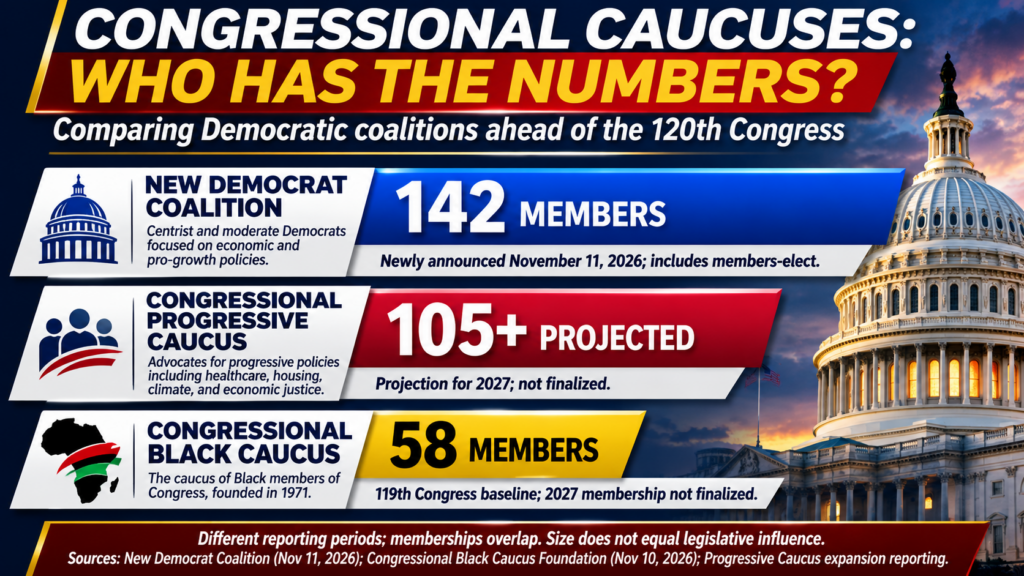
Understand something. The Congressional Black Caucus does not have to lose its membership to lose its influence. It can become politically marginalized when other coalitions develop enough negotiating power to determine what legislation moves forward and what issues receive priority.
We are also witnessing a changing demographic among elected officials. More representatives come from immigrant families and communities with different historical experiences. There is nothing wrong with those communities seeking political representation. However, we must stop pretending that everybody who experiences discrimination automatically understands the historical experience of Black Americans descended from slavery.
Our ancestors endured centuries of American slavery, followed by Jim Crow, government-sanctioned segregation, discriminatory housing policies, and generations of economic exclusion. That history created specific economic disadvantages that cannot simply be addressed by placing everybody under the same political umbrella.
Other communities have their interests. Black America has its interests. Those interests may overlap, but they are not always identical.
EVERYBODY HAS AN AGENDA EXCEPT THE PEOPLE WHO KEEP DELIVERING THE VOTES
Listen to the political conversations coming out of Washington. We hear about immigration reform, protections for migrants, Medicare for All, climate change, international conflicts, and opposition to Donald Trump. Some of these issues may be important, and some may benefit Black Americans. But where is the urgency surrounding Black homeownership, Black business development, generational wealth, educational achievement, and the economic condition of descendants of American slavery?
Where is the serious discussion about H.R. 40 and studying reparations? Where is the national strategy for increasing Black ownership of land, housing, and businesses? Where is the commitment to rebuilding the economic foundation of Black communities?
The Congressional Black Caucus has identified economic development, education, healthcare, and other issues among its priorities. I recognize that. But identifying an issue is not the same as securing legislation, funding, and measurable results.
And please stop telling me that Medicare for All is automatically a Black American agenda. It is a universal healthcare proposal. Black Americans may benefit from it, but that does not make it a targeted remedy for the historical economic damage experienced by our community.
The same applies to immigration policy. We can recognize the humanity and constitutional rights of immigrants without pretending immigration reform is a substitute for a Black American economic agenda.
BLACK LEADERSHIP HELPED CREATE THIS POLITICAL REALITY
Here is the part that some Black elected officials and political leaders may not want to discuss. They helped build the political environment they are now operating in.
For years, Black political leadership has embraced broader progressive movements, supported candidates outside our community, and encouraged Black voters to place party loyalty above independent political interests. In some cases, they have welcomed political movements into Black communities without demanding reciprocal commitments addressing our specific economic needs.
Now those movements are developing their own leadership, expanding their congressional representation, and negotiating their own political priorities.
What did our political leaders think was going to happen?
Political organizations exist to advance the interests of their members and supporters. That is how politics works. Why should Black America expect other constituencies to abandon their agendas simply because Black voters helped elect Democrats?
The real question is why our own leadership has not consistently demanded the same level of accountability.
THE CONGRESSIONAL BLACK CAUCUS MUST DECIDE WHAT IT REPRESENTS
I respect the history of the Congressional Black Caucus. Established in 1971, it became an important institution for Black political representation during a period when Black Americans were fighting to expand their presence in Congress.
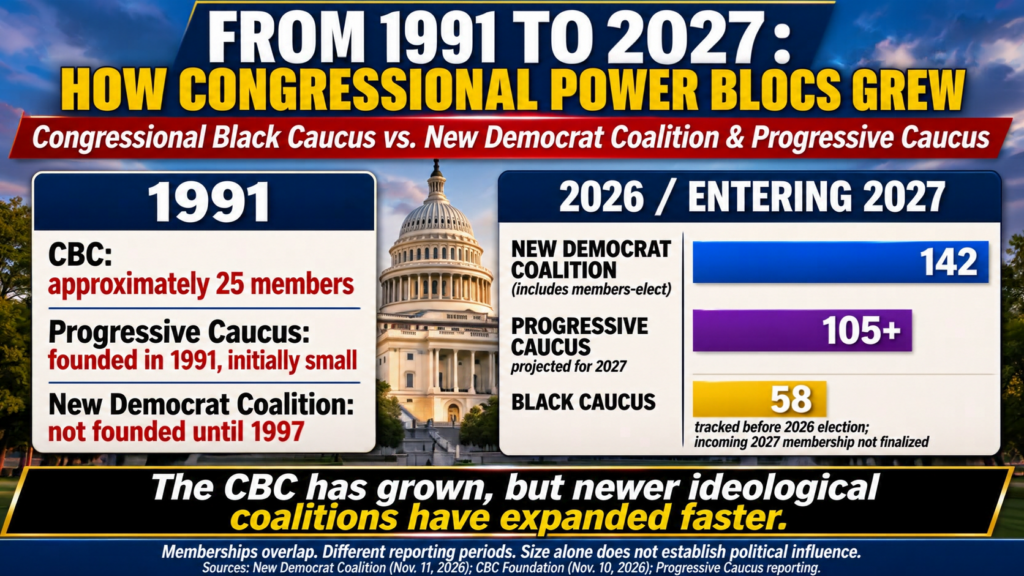
But history alone cannot guarantee future political influence.
The CBC must demonstrate that it can negotiate specific legislative commitments for Black Americans while working with the broader Democratic coalition. That means publicly identifying priorities, establishing measurable objectives, and explaining what political concessions it is prepared to seek.
It also means understanding that Black representation and representation of the specific interests of descendants of American slavery are not necessarily the same thing. An elected official’s race does not automatically determine their political priorities, just as another official’s ancestry does not automatically make that person an opponent of Black American interests.
The standard must be what elected officials actually do.
BLACK AMERICA MUST STOP CONFUSING ACCESS WITH POWER
I have said it before, and I will continue saying it. Voting expresses preference. Funding creates obligation. Political power requires organization, negotiation, and accountability.
Black America cannot continue measuring political success by how many Democrats win elections, how many Black politicians attend press conferences, or how many invitations our leaders receive to the White House.
We must measure political success by what happens to our communities after the election is over.
Are more Black families becoming homeowners? Are Black businesses expanding? Are our children receiving the education necessary to compete economically? Are we reducing the racial wealth gap? Are we building institutions that will survive beyond the next election cycle?
If the answer to these questions continues to disappoint, then we have every reason to question the political strategy being presented to our community.
I am an Independent because I do not believe either political party deserves automatic loyalty. Political parties should be held accountable for what they deliver, not celebrated simply because they win.
So, will the Congressional Black Caucus become obsolete in 2027 and beyond?
That remains to be seen. But its relevance cannot be measured by its history, membership numbers, or proximity to Democratic leadership. It must be measured by its ability to advance concrete policies addressing the interests of the people it was created to represent.
Black America does not need another political celebration. We need political accountability, economic independence, and an agenda that belongs to us.
And if our elected leadership cannot explain what Black America is getting from this new Congress, then perhaps the most important question is not whether the Congressional Black Caucus will become obsolete.
The question is whether Black Americans will continue accepting political representation without demanding political results.
