

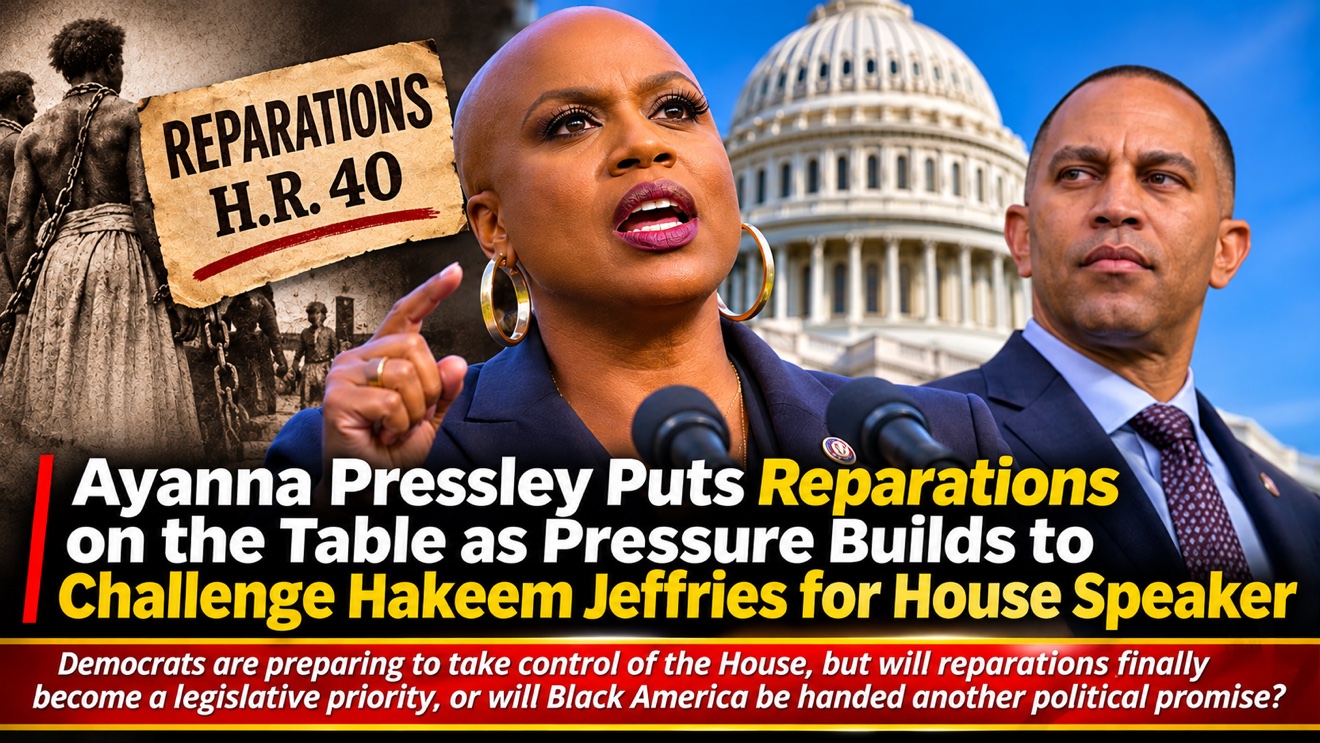
Democrats are preparing to take control of the House, but will reparations finally become a legislative priority, or will Black America be handed another political promise?
By Damon K. Jones | Publisher, Black Westchester Magazine
Something interesting is happening inside the Democratic Party, and Black America should be paying close attention. Congresswoman Ayanna Pressley of Massachusetts has placed reparations at the top of her legislative agenda as progressive activists push for her to challenge Congressman Hakeem Jeffries for Speaker of the House.
Pressley has not officially announced that she is running for Speaker, but that has not stopped a growing movement from promoting her as an alternative to Jeffries. Reports indicate that a petition supporting her has attracted more than 130,000 signatures.
What makes this situation interesting is not simply the possibility of one Black elected official challenging another. It is the fact that reparations for the descendants of American slavery are now being discussed as part of a larger fight over Democratic leadership.
For decades, Black Americans have been among the Democratic Party’s most dependable voters. We have helped elect presidents, governors, senators, and members of Congress. We have been told repeatedly that Democrats represent our interests, but after every election, we are left asking the same question: What exactly did Black America receive for its loyalty?
Now that Democrats are preparing to take control of the House in January, that question deserves an answer.
Pressley puts reparations first
On November 15, Pressley outlined her priorities for the incoming Democratic majority. Reparations through H.R. 40 appeared at the top of her agenda, followed by Medicare for All, abortion protections, abolishing ICE, universal child care, paid family leave, and affordable housing.
I find it interesting that reparations are suddenly receiving this level of attention while Democrats are fighting over their future leadership. I welcome serious discussion about reparations, but Black America should not confuse a political announcement with an actual legislative accomplishment.
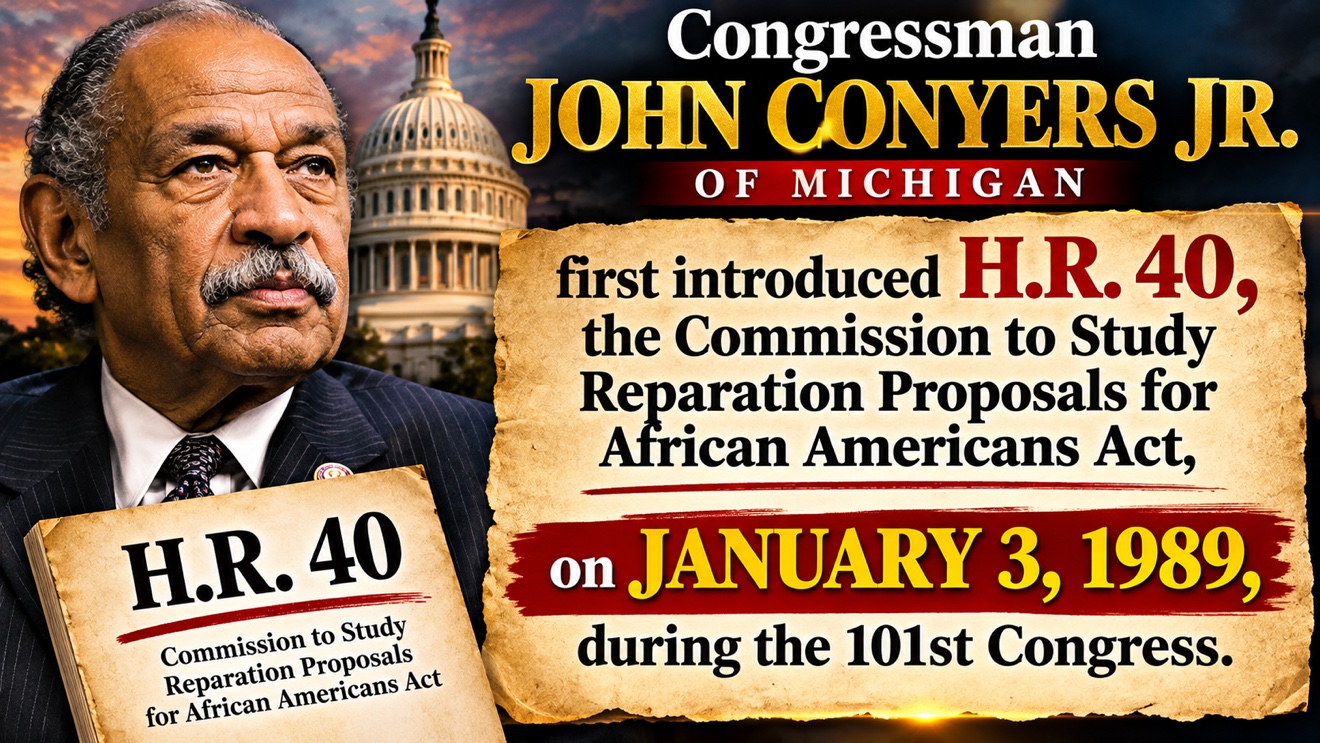
H.R. 40 would establish a federal commission to study slavery, its continuing consequences, and possible reparative remedies. It does not authorize direct payments to descendants of American slavery.
And that raises a question I have been asking for years. How much longer does the federal government need to study an injustice that is already documented throughout American history?
We know slavery existed. We know the federal government protected it. We know what happened during Jim Crow, segregation, redlining, and decades of discriminatory housing and lending practices. We know Black Americans were denied opportunities to accumulate wealth and pass property down to future generations.
At some point, studying an injustice must become correcting it.
What does this mean for Hakeem Jeffries?
Hakeem Jeffries is positioned to become the first Black Speaker of the House if Democrats elect him to lead their new majority. That would be a historic accomplishment, but history alone does not pay bills, create businesses, increase homeownership, or close the racial wealth gap.
The progressive movement supporting Pressley has criticized Jeffries and the Democratic establishment for not moving aggressively enough on its priorities. However, Pressley herself has not declared a leadership challenge, and her office has acknowledged ongoing discussions with Jeffries about the party’s legislative agenda.
I am not interested in turning this into a personality contest between two Black politicians. My concern is what either one intends to deliver for the Black Americans whose votes have helped sustain the Democratic Party.
Black representation matters, but representation without measurable results cannot be the final goal.
If Pressley wants reparations to become a priority, what is her legislative plan? If Jeffries wants to lead the Democratic majority, will he commit to hearings, committee action, and a House vote on H.R. 40?
These are reasonable questions, especially when Black Americans have spent generations waiting for the federal government to seriously address its historical obligations.
Reparations cannot become another political bargaining chip
There is something else Black America should consider. Pressley’s reparations proposal is being presented alongside a broader progressive agenda that includes immigration policy, universal health care, and expanded government programs.
Those issues deserve their own debates, but reparations for descendants of American slavery represent a specific historical claim against the United States government.
Our ancestors were enslaved under American law. Their unpaid labor helped build the nation’s economy, while generations of their descendants faced laws and policies that restricted their ability to own property, accumulate wealth, and participate equally in American society.
The 13th, 14th, and 15th Amendments emerged from the struggle to end slavery and establish citizenship and political rights for formerly enslaved Black Americans. Those constitutional protections eventually benefited many others, but the descendants of American slavery are still seeking remedies for the particular injustices their families experienced.
That history should not be buried inside a political agenda where every issue is treated as interchangeable.
I believe reparations should include a serious discussion about direct compensation, land and property ownership, access to capital, business development, and generational wealth. The objective should be economic restoration, not simply creating another government program that leaves Black Americans dependent on politicians.
Black voters must demand accountability
One of the biggest problems in Black politics is that we have become comfortable celebrating elections without measuring what happens afterward.
We celebrate when a Black candidate wins. We celebrate when Democrats take control of Congress. We celebrate when someone from our community receives a leadership position. But celebrating political victories is not the same as improving the economic condition of our communities.
Black voters have given Democratic presidential candidates overwhelming support for decades, often approaching 90 percent. That kind of loyalty should come with clear expectations and measurable accountability.
Political organizations and special-interest groups understand how this works. They organize around specific demands, negotiate with candidates, and measure legislative results. Black America should be doing the same thing.
We need stronger families, better schools, safer communities, greater homeownership, more Black-owned businesses, and opportunities to build generational wealth. Those priorities should not disappear every time another political movement demands the Democratic Party’s attention.
I have said it before, and I will say it again: Voting expresses preference. Funding creates obligation. But neither should replace the responsibility to hold elected officials accountable.
January will tell us what Democrats are serious about
When the new Congress convenes, Democrats will have an opportunity to demonstrate whether reparations are a genuine legislative priority or another issue used to generate excitement among Black voters.
Controlling the House does not guarantee that reparations legislation will become law. The Senate and the president remain part of the legislative process. However, House leadership can help determine whether legislation receives hearings, committee consideration, and a floor vote.
That is where the accountability begins.
If Pressley is serious, let us see the plan. If Jeffries supports reparative justice, let us see what he is prepared to advance. And if Democrats believe Black Americans deserve historical justice, let them demonstrate that commitment through legislative action rather than campaign speeches.
I am not opposed to either Pressley or Jeffries because of their political affiliations. I am concerned about whether Black Americans will continue giving their political power away without demanding anything specific in return.
Malcolm X warned us more than 62 years ago about politicians who seek Black votes through promises that never produce meaningful change. His warning remains relevant because the fundamental question has not changed.
What are we getting for our vote?
Black America cannot afford another election cycle filled with promises, celebrations, and excuses. We need accountability, economic independence, and measurable results.
Whether Ayanna Pressley becomes Speaker, Hakeem Jeffries becomes Speaker, or the Democratic leadership remains unchanged, the responsibility of Black America is the same.
We must stop confusing political access with political power.
Only Black America can save Black America.
