

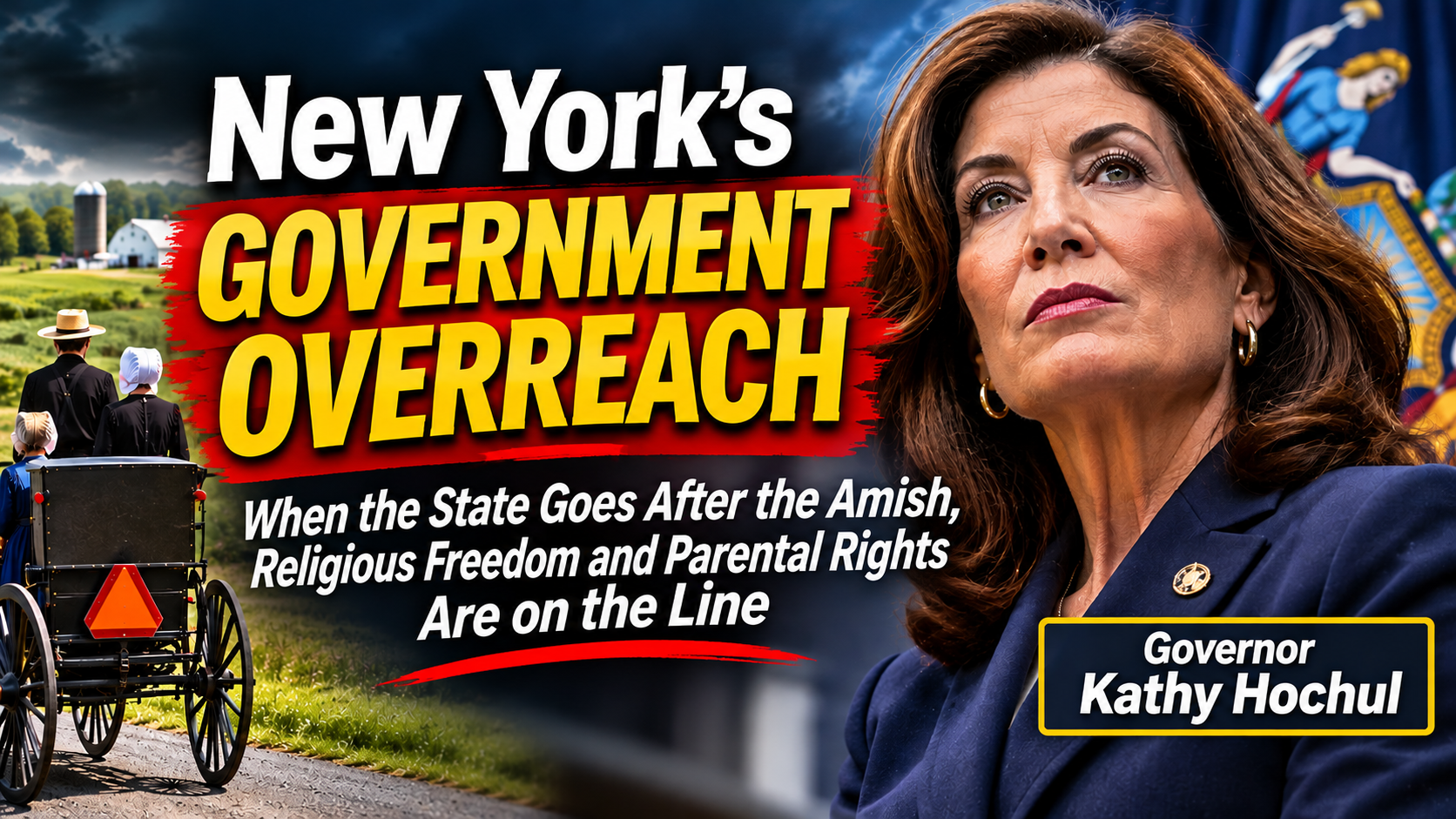
The battle over religious freedom, parental rights, and government power is bigger than vaccinations. It is about how much control we are willing to surrender to the state.
There is something seriously wrong when a government that claims to protect freedom begins punishing people for living by their religious convictions. And before anyone tries to turn this into a Republican or Democratic issue, let me be clear. This is about government power, individual liberty, and the dangerous idea that the state should have the final say over how people raise their children.
What New York State is doing to the Amish community should concern every New Yorker, regardless of race, religion, or political affiliation. Today it is the Amish. Tomorrow it could be another religious community, a small-business owner, or ordinary citizens who find themselves on the wrong side of government policy. We have become so comfortable letting government make decisions for us that we sometimes forget that government is supposed to serve the people, not control them.
I am not writing this to debate whether vaccines work. Vaccines have an established role in preventing serious diseases, and the government has a legitimate responsibility to protect public health. But that responsibility does not mean we should stop questioning how the government exercises its authority, particularly when its enforcement threatens the existence of small religious institutions.
The Amish are not the enemy
The Amish are among America’s most self-reliant religious communities. They generally live quietly, work their land, run small businesses, educate their children, and maintain a way of life centered on family, faith, and community responsibility. They do not demand that everyone else live according to their beliefs or attempt to impose their traditions on the rest of society.
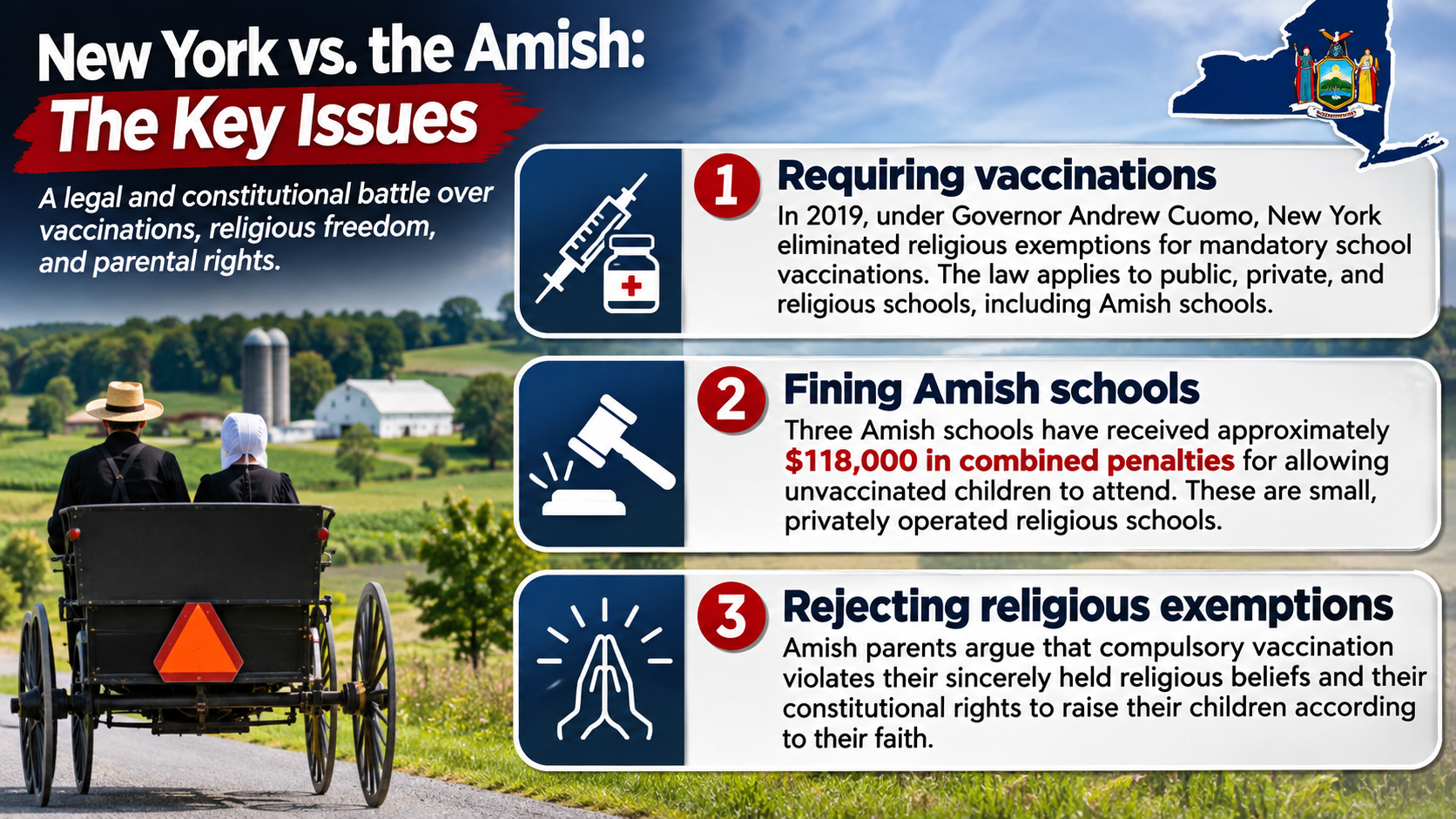
Yet three Amish schools in New York have faced approximately $118,000 in combined fines for allowing unvaccinated children to attend their religious schools. These are not wealthy institutions with millions in reserve. They are small community schools operated by families who believe that educating their children according to their religious convictions is part of their way of life.
In 2019, under former Governor Andrew Cuomo, New York eliminated religious exemptions to mandatory school vaccinations after a major measles outbreak. The law applies to public, private, and religious schools. Medical exemptions remain available, but religious objections no longer qualify.
The state argues that its policy protects public health, a legitimate concern, especially when dealing with highly contagious diseases. But we should still ask whether imposing substantial financial penalties on small religious schools is proportionate and whether the government has adequately considered the consequences for these families.
When did government become the parent?
One of the most troubling developments in American politics is the growing assumption that government officials know what is best for every family, regardless of each family’s circumstances, values, or beliefs. Parents have the primary responsibility for raising their children, meeting their needs, and making decisions about their education and upbringing.
Government certainly has a responsibility to protect children from abuse, neglect, and serious threats to their safety. But that responsibility should not automatically translate into unlimited authority over parental decisions. There must be clear boundaries between protecting children and unnecessary interference with family life.
The Amish have challenged New York’s vaccination requirements in federal court, arguing that the law violates their religious freedom and parental rights. In June 2026, the Second Circuit Court of Appeals upheld New York’s position, after which the Amish petitioned the United States Supreme Court for review.
The courts have long recognized that states have substantial authority to enforce vaccination requirements. Religious freedom does not automatically exempt individuals from generally applicable public health laws. Nevertheless, the public still has every right to question the fairness and proportionality of government enforcement.
Government overreach does not always come with handcuffs
When people hear the term government overreach, they often picture police officers showing up at someone’s home or government agents seizing property. But excessive government power can also be exercised through regulations, administrative penalties, and financial pressure that ordinary citizens cannot afford to challenge.
The state need not physically close a religious school to threaten its existence. Financial penalties can impose serious hardship on small institutions with limited resources. That is why the Amish situation warrants examination beyond the question of whether the state has the legal authority to enforce its vaccination requirements.
As Black Americans, we should understand the importance of questioning government authority. Our history includes generations when government institutions enforced laws that restricted where Black people could live, which schools our children could attend, and whether we could participate equally in American society.
I am not comparing the Amish vaccination dispute to slavery, segregation, or Jim Crow. Those are fundamentally different historical contexts. But our experience should have taught us that government power must always be subject to public scrutiny, especially when it affects communities with limited political influence.
The fact that something is legal does not automatically mean every aspect of its enforcement is fair. Likewise, the fact that elected officials believe a policy serves the greater good does not eliminate their responsibility to explain its consequences.
New York has some explaining to do
Governor Kathy Hochul did not create the 2019 law eliminating religious vaccination exemptions, but her administration continues to defend New York’s requirements. The question is whether the state has properly balanced its responsibility to protect public health against the burdens its policies impose on small religious communities.
Why were these financial penalties necessary? Were the penalties proportionate to the violations? Did the state adequately consider the circumstances of Amish schools, and could alternative enforcement approaches protect public health without imposing the same financial hardship?
These are legitimate questions that deserve answers. Asking them does not mean someone opposes vaccination or believes that religious communities should be exempt from every law. It means citizens expect the government to exercise its authority responsibly.
And that is where political hypocrisy often enters the conversation. Too many Americans defend government power when their preferred political party controls it, only to complain about that same power when the opposing party takes office. Constitutional protections should not change depending on which political party occupies the governor’s office.
Today it is the Amish. Tomorrow, who is next?
What concerns me most is how easily Americans have become divided over issues that should prompt broader conversations about government accountability. If someone disagrees with the Amish position on vaccination, they may have little sympathy for their situation. But constitutional protections shouldn’t depend on whether someone’s beliefs are popular.
The Amish have the right to challenge government policies, just as New York has the responsibility to defend legitimate public health protections. The public also has the right to question whether the state’s enforcement practices are appropriate and whether the consequences justify the approach.
What makes this case even more concerning is the precedent it could set for churches, private schools, and other religious institutions. If the government can impose substantial financial penalties on Amish schools for refusing to comply with a law that conflicts with their religious convictions, what happens when the next government mandate challenges the beliefs or practices of Christian schools, churches, or other faith-based organizations?
Although courts have long recognized the government’s authority to enforce public health laws, decisions like this raise serious questions about where that authority ends. We should not have to wait until government policies threaten our own churches or our children’s schools before we become concerned about others’ rights.
The danger is not only what New York is doing to the Amish today but also how the legal reasoning in this case could be used to justify future restrictions on religious institutions.
We elect governors and legislators to govern, not to become unquestionable authorities over every aspect of our personal lives. A healthy society requires public safety, individual responsibility, constitutional protections, and limits on government power.
My concern is not that New York has vaccination laws. My concern is whether the state is exercising its authority with the restraint, fairness, and respect for individual liberty citizens should expect.
The true test of freedom is not how government treats people who agree with its policies. It is how government treats those who respectfully disagree. And while the courts have upheld New York’s requirements, that does not mean citizens must stop examining those policies or their consequences.
New Yorkers should be paying attention to what is happening to the Amish community, because this debate is bigger than three schools and their financial penalties.
Government is supposed to serve the people, not the other way around. And when government begins forgetting that distinction, it becomes the responsibility of the people to remind it.
