

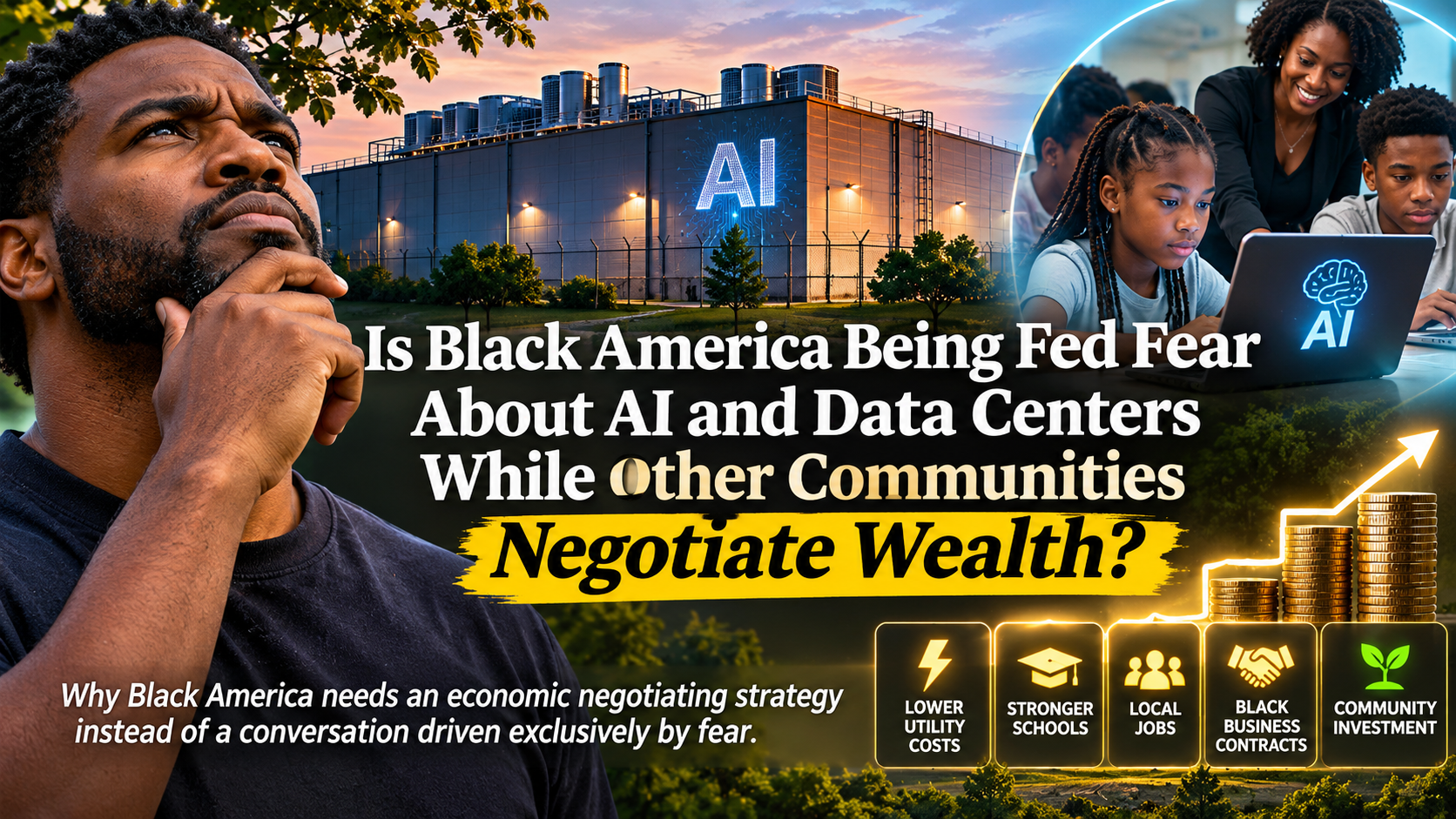
A growing conversation surrounds artificial intelligence and the construction of data centers across America, but I question whether Black communities are being shown the full picture. Much of what we hear focuses on environmental dangers, electricity consumption, water usage, corporate greed, and the potential loss of jobs. While these concerns deserve serious consideration, where is the equally aggressive conversation about economic opportunity, community compensation, educational investment, and negotiating power?
We must also acknowledge the contradiction in some of these conversations. Nearly all of us already use artificial intelligence or services powered by AI and data centers, whether we realize it or not. When we use our smartphones, search the internet, navigate with GPS, conduct banking transactions, shop online, use social media, or access modern healthcare services, we are participating in an increasingly technology-driven economy. Artificial intelligence is becoming embedded in our everyday lives, and it is not going away.
The question is not whether Black America can stop artificial intelligence. The question is whether Black America will position itself to benefit economically from its expansion or, once again, find itself on the outside of a major economic transformation.
Are We Being Educated or Conditioned to Fear?
Throughout American history, technological advancements have created new industries, new employment opportunities, and new generations of wealth. However, Black Americans have often faced barriers to ownership, investment, education, and meaningful participation in these economic transformations. We have often become consumers of industries in which we have limited ownership.
Today, we are witnessing another technological revolution, yet much of the public discussion about Black communities emphasizes what we should fear. We hear about what corporations will take from our communities, but not nearly enough about what our communities could negotiate with these corporations. We hear about environmental activism, but where is the comprehensive economic strategy that accompanies it?
I am not suggesting that every environmental concern is manufactured or that every data center project deserves approval. What I am questioning is whether a fear-dominated conversation leaves our communities economically unprepared. There is a significant difference between educating people about potential dangers and presenting technological development as something from which they can only suffer.
Stop Thinking Exclusively About Protest and Start Thinking About Negotiation
When a multibillion-dollar corporation seeks to build a data center in or near a Black community, it needs land, electricity, water, infrastructure, permits, and government cooperation. These requirements create potential negotiating leverage. The question is whether our community leadership understands how to use that leverage to secure long-term benefits for residents.
Why aren’t we discussing guaranteed financial contributions for local school districts? Why aren’t we demanding residential electricity subsidies, property tax relief, community development funds, and infrastructure improvements? Why aren’t we discussing annual compensation agreements that could benefit the residents who will live alongside these facilities for decades?
If a corporation is going to generate substantial revenue from infrastructure connected to our communities, residents should have an opportunity to share in the economic benefits. These negotiations should occur before construction begins, before tax incentives are approved, and before corporations receive the necessary government authorizations.
Black communities need attorneys, economists, engineers, environmental specialists, financial professionals, and experienced negotiators at the table. Protesting a corporation may draw attention to an issue, but negotiating an enforceable agreement can deliver financial benefits for generations.
Why Aren’t We Negotiating Compensation for Electricity?
One of the biggest concerns about data centers is the enormous amount of electricity they consume. Residents are understandably concerned that increased demand could lead to higher electricity bills, additional infrastructure costs, and greater pressure on the electrical grid.
However, this concern should also be a central part of the negotiation. Why should working-class residents, senior citizens, and struggling families absorb additional electricity costs because a multibillion-dollar corporation wants to expand its operations? Corporations should be responsible for the infrastructure upgrades and additional generating capacity needed to support their facilities.
Beyond protecting residents from cost increases, communities could negotiate company-funded residential electricity credits, energy assistance programs, home weatherization improvements, and investments in more efficient heating and cooling systems. Such arrangements would require cooperation among utility companies, regulators, and local governments, but they deserve to be part of the discussion.
Imagine senior citizens receiving help with their monthly electricity bills because a data center operates within their municipality. Imagine homeowners receiving financial assistance to install energy-efficient equipment. Instead of residents simply bearing the burden of higher energy consumption, negotiated agreements could help ensure that corporate development contributes to household financial stability.
Data Centers Could Help Transform Black Public Schools
Black communities have spent decades demanding greater investment in public education. We have discussed underfunded schools, outdated technology, inadequate facilities, limited extracurricular programs, and a lack of educational opportunities needed to compete in a changing economy.
Now we have an expanding industry built around technology, with corporations investing billions of dollars in physical infrastructure. Why aren’t educational investments a primary component of every major data center negotiation?
Communities could negotiate guaranteed annual contributions to school districts and fund state-of-the-art computer laboratories, artificial intelligence training programs, cybersecurity education, robotics programs, scholarships, and paid internships. Corporations could also partner with historically Black colleges and universities, community colleges, and vocational schools to develop the next generation of technology professionals.
Our children should not simply grow up using artificial intelligence developed and owned by others. They should be learning to develop, manage, and maintain it, and to build businesses around it. Education must become part of the economic agreement, not an afterthought or a charitable donation that corporations can discontinue at will.
Other Communities Understand the Economic Value
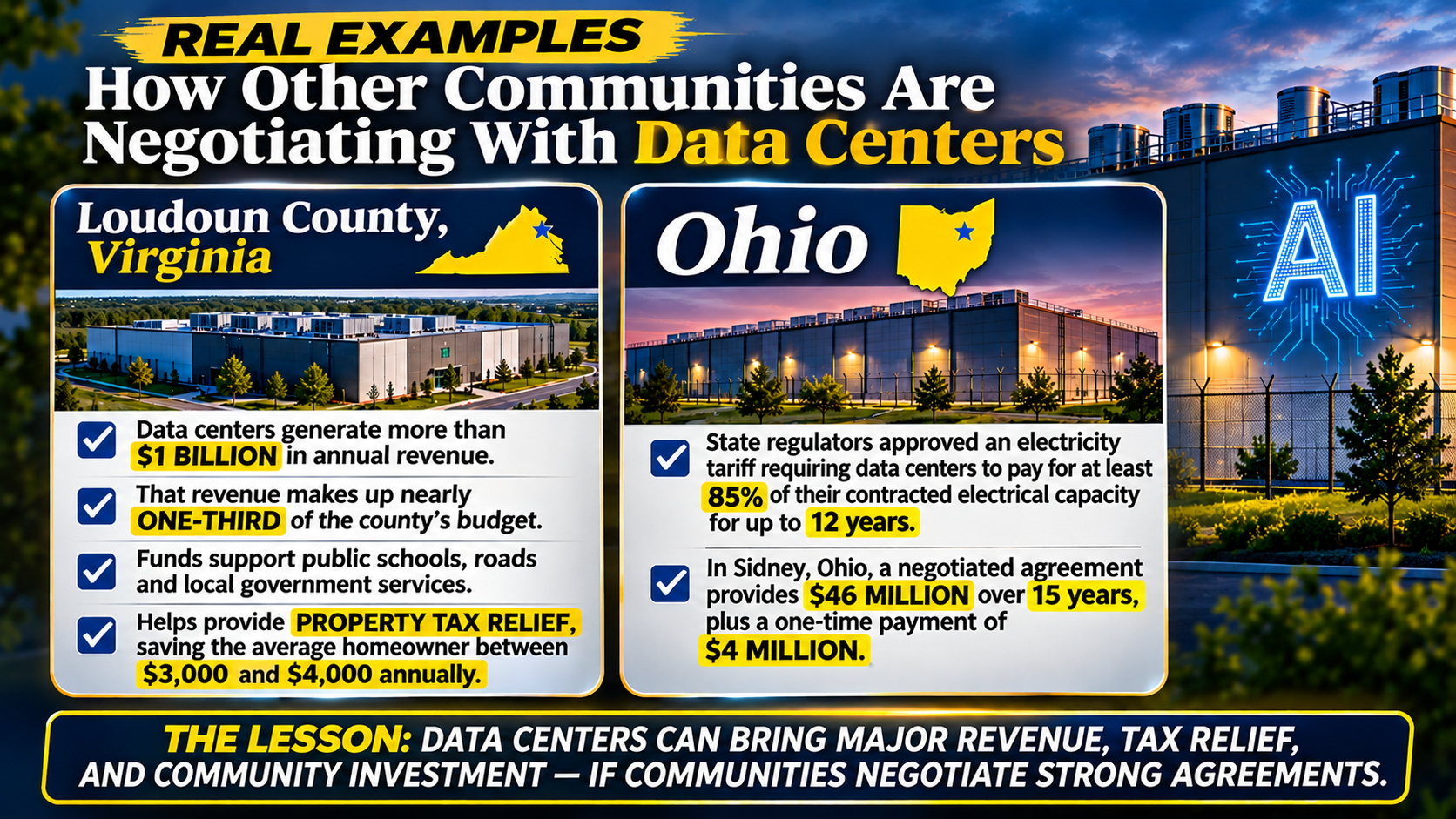
Loudoun County, Virginia, exemplifies how data center development can generate substantial revenue for local government. The county’s extensive data center industry has helped support public services, school funding, infrastructure, and property tax relief. Although Loudoun County’s circumstances cannot be replicated everywhere, its experience demonstrates the fiscal potential of these facilities.
In Ohio, regulators have taken steps to establish special electricity requirements for large data centers to help protect other utility customers from the financial risks associated with increased electricity demand. These arrangements demonstrate that governments and regulators have mechanisms to address concerns without necessarily rejecting technological development altogether.
Black communities should study these economic models. We should examine successful agreements, identify their shortcomings, and develop negotiating strategies that reflect our residents’ specific needs. We should not assume that the only options are to accept whatever corporations offer or to oppose development entirely.
Environmental Protection and Economic Development Can Coexist
Clean air, safe drinking water, affordable electricity, and public health are nonnegotiable. Black communities have endured enough environmental injustice to understand the importance of independent monitoring, government oversight, and corporate accountability. No financial agreement should allow a corporation to endanger residents’ health.
However, environmental protection and economic development need not be opposing objectives. Communities can demand strict environmental standards while negotiating financial compensation, infrastructure investment, educational funding, and employment opportunities. When environmental risks cannot be adequately addressed, communities have every reason to challenge a proposed development.
The conversation must include independent environmental assessments, transparent reporting of water and electricity use, enforceable pollution standards, and financial penalties for violations. Economic benefits should supplement, not replace, environmental protections.
We All Use AI, and It Is Not Going Away
As a publisher, I understand how technology has transformed the media industry. Artificial intelligence gives independent publishers, entrepreneurs, and small businesses capabilities that once required substantial financial resources and large staffs. From research and content development to marketing, graphic design, video production, and business administration, AI is reshaping how people run their businesses.
For Black entrepreneurs who have historically faced challenges accessing capital, artificial intelligence can help reduce operating expenses and increase productivity. It can provide smaller businesses with tools that were previously available primarily to large corporations. That does not eliminate the risks of inaccurate information, job displacement, or algorithmic discrimination, but it creates opportunities that merit serious examination.
We cannot use artificial intelligence to run our businesses, promote our organizations, communicate with our families, educate our children, and manage our daily lives while pretending the infrastructure that supports these technologies is unnecessary. We must be intellectually consistent about the technology we use and the infrastructure required to support it.
Black America Needs an Economic Negotiating Agenda
What would happen if Black communities developed a comprehensive framework for negotiating with data center developers? Such a framework could include guaranteed annual community compensation, residential electricity credits, property tax relief, public school funding, contracting opportunities for Black-owned businesses, workforce development, technology scholarships, homeownership assistance, infrastructure improvements, and independent environmental monitoring.
These benefits should be incorporated into legally enforceable agreements that include clear financial commitments, reporting requirements, deadlines, and penalties for noncompliance. Corporations should not receive billions in potential economic benefits while residents receive nothing more than promises of employment and occasional charitable contributions.
Black leadership must broaden its understanding of economic power. We must be able to identify legitimate dangers while recognizing legitimate opportunities. We must know how to negotiate with corporations, evaluate financial agreements, protect taxpayers, and secure measurable benefits for the communities we represent.
Artificial intelligence is not going away. Data centers will continue to be built as demand for computing infrastructure grows. The fundamental question is whether Black America will participate in shaping the economic conditions surrounding that development or remain primarily a consumer of the technology while others accumulate wealth.
We cannot afford another generation of technological advancement in which Black America consumes the products, provides the customers, and bears the costs while other communities negotiate the economic benefits. Our future requires more than fear, protest, and reaction. It requires education, ownership, preparation, negotiation, and a comprehensive understanding of economic power.
Only Black America can save Black America, and that requires understanding how to turn technological advancement into economic opportunity, community investment, and generational wealth.
